A kind of visualisation that has become very popular in recent months is the “bar chart race” that compares things on one attribute, over a long time period. You may already have seen chart races of the most popular YouTubers or songs, but some of the most eye-opening races show an aspect of economic history.
Guest post from J. Brian O’Roark, University Professor of Economics at Robert Morris University in Pittsburgh and author of Why Superman Doesn’t Take Over the World.
“Why are they fighting? Aren’t they supposed to be friends?” My wife and I were watching television when a commercial trumpeting the coming of the movie Batman vs. Superman appeared. She was understandably confused. My first instinct was to launch into an in depth dissertation on the comic origins of the battle between DC Comics’ oldest and most renowned heroes. But her question, innocent though it was, resonated at a deeper level.
As an economist, I am supposed to be able to explain things like unemployment, inflation and the future of Bitcoin, but more fundamentally I should be able to offer some insight into the behaviors of people – even if those people are wearing capes and spandex. I think my wife was happy that her question left me speechless, having no desire to hear about the intricacies of what prompts two men in tights to want to mash each other, but her query needed an answer. As it turns out, the question was perfectly situated for an economist who always wanted to be a superhero.
In this short video from the Royal Economic Society, Gill Wyness of University College London explains the long-term financial benefits to individuals who do a degree. Bear in mind that the benefits are especially high if your degree subject includes economics, as you can see elsewhere on our site.
“Economics…Understand the world around you” is a short video from the Women’s Economics Network, speaking to economists in banking, academia, commerce about what their jobs involve and how their economic thinking is crucial to their work.
The Economics Society of the London School of Economics and Political Science’s Student Union (LSE SU) has announced an essay competition that is open to sixth-form students in the UK and beyond. Write no more than 2,000 words on one of the listed questions, and you can win Amazon vouchers of up to £125, and the top three entries will be published by the Society in their journal Rationale.
The questions for this year are:
Can Economics tell us anything about how we can try to prevent war?
Imagine that in front of you is a Big Red button. If you press the button, everyone in the world would have their wealth magically equalised. Would you press the button? Explain the economic reasoning behind your decision
Discuss the effect of the rise of ad blocker software on the Internet – is it a blessing or a curse?
‘Free trade is a necessary evil’. How far do you agree?
‘On a societal level, University Education is inefficient – for most people, it hardly makes them better at their future jobs, but it comes at a huge opportunity cost because students miss out from entering a career earlier. Most people who go to university only do so because they’d be left behind in the job market if they didn’t go and everyone else did’. With reference to this argument, should the government drastically limit the number of university places available?
The deadline is on 1st August 2017. Follow the above link for more details, and good luck!
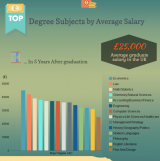
The Market Inspector blog has posted an infographic to answer the question “what degree subject is most likely to get you hired with a good salary?” Using data from emolument.com, they found that economics comes out top of subjects taken in the UK, going by average salaries five years after graduation. This won’t be a surprise if you’ve read our previous posts on the topic.
The infographic gives another statistic that we hadn’t heard: eight percent of the world’s billionaires took degrees in Economics!